
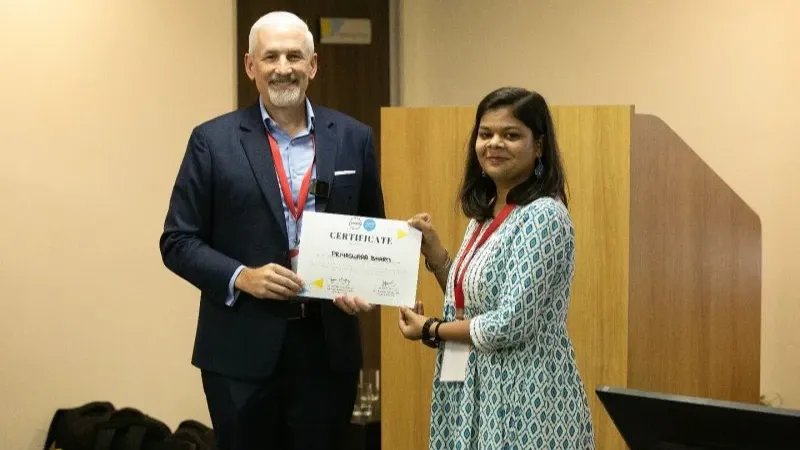
Empowering Change Through Child Rights and Storytelling, Priyaswara Bharti from Bihar founded Bihar Youth for Child Rights, collaborated with UNICEF, created documentaries on dowry and trans rights, and is building a generation of informed, empowered young advocates.
Empowering Change Through Child Rights and Storytelling
Can you tell us a little about yourself and your background? How did you become interested in advocating for child rights and documentary filmmaking?
Hello, I’m Priyaswara Bharti, often called “Prabhavshali Priyaswara.” Originally from Gopalganj, I’ve been living in Patna, Bihar, since 2009, where I completed my mass communications degree from Patna University. My journey in child rights advocacy and documentary filmmaking is rooted in meaningful experiences that shaped my perspective.
My advocacy began in 2017 with the founding of “Bihar Youth for Child Rights.” A pivotal moment was attending a 2013 workshop on Bal Niti, which aimed to simplify child rights policies for children. This experience opened my eyes to social issues, inspiring me to raise awareness among vulnerable children. Child Rights and Storytelling became the twin pillars of my life from the moment I walked out of that workshop with a new understanding of the world.
A turning point came during a UNICEF meeting where I was the only child present in discussions about media representation. This highlighted the need for children’s involvement in decisions affecting them. With UNICEF’s guidance, I launched initiatives to empower youth and amplify their voices.
My passion for documentary filmmaking emerged during my time with “Khilkari” where I honed my skills through workshops and projects. This blend of advocacy and storytelling drives me to create meaningful change and inspire transformation through my work. Child Rights and Storytelling are not separate pursuits for me they are two sides of the same coin, each making the other stronger and more impactful.
What motivated you to establish Bihar Youth for Child Rights? Could you share some of the key goals and initiatives of the organization?
The lack of awareness among children about critical social issues and their underrepresentation motivated me to start “Bihar Youth for Child Rights.” The initiative focuses on bridging gaps in youth participation and representation, empowering individuals aged 9 to 25.
We address topics like sexual and reproductive rights, gender equality, and child marriage through campaigns and activities. By equipping youth with knowledge and tools, we prepare them to tackle challenges and seize opportunities in an evolving world, fostering a generation of informed, empowered citizens. Child Rights and Storytelling are at the heart of everything Bihar Youth for Child Rights does — because you cannot change what people do not understand and you cannot make them understand without telling the right story.
Could you tell us about your involvement with the Young People’s Action Team? What kind of activities and initiatives does the team undertake?
As part of UNICEF’s Young People’s Action Team, I contribute to shaping youth-focused policies and programs. This diverse team advises UNICEF on issues relevant to young people.
We participate in board meetings, volunteer for initiatives, and offer insights that guide impactful campaigns. Our work bridges the gap between global decision-making and youth perspectives, ensuring that young voices influence meaningful change. Child Rights and Storytelling found a global platform through my work with UNICEF’s Young People’s Action Team, where young voices are not just heard but actively shape the policies that affect millions of children worldwide.
As a documentary filmmaker, you’ve focused on the issue of dowry in Bihar. What prompted you to choose this subject for your films? What impact do you hope to achieve through your documentaries?
Growing up in Gopalganj, I witnessed child marriages and dowry practices as normalized traditions. Moving to Patna exposed me to the power of films as tools for change.
Through my documentaries, I aim to unravel the harmful impact of dowry, ignite critical conversations, and challenge deep-rooted societal norms. My goal is to inspire collective action and pave the way for a more equitable society. Child Rights and Storytelling came together most powerfully in my documentary work — because a film about dowry is not just a story about a social problem, it is a demand for justice told through the most human of mediums.
One of the campaigns you led focused on preventing stigma and discrimination during the COVID-19 pandemic. How did you address these issues, and what were the key outcomes?
During the pandemic, misinformation and discrimination surged. Through the “Ab Meri Bari” initiative with Dasra, we launched the “Help and Heal” campaign under “Bihar Youth for Child Rights.”
We guided individuals through vaccination, debunked myths, and addressed stigma with impactful short videos. These efforts fostered unity, dispelled fears, and encouraged shared resilience in combating the pandemic. Even during a global crisis, Child Rights and Storytelling remained my most powerful tools because short videos debunking myths and spreading hope are stories too, and they saved lives.
What challenges have you faced as a child rights advocate and filmmaker? How did you overcome them?
Coming from a modest financial background, I faced hurdles like irregular schooling and limited resources. Despite this, I defied stereotypes, self-taught myself, and relied on resourcefulness to pursue my education and advocacy.
Tutoring, freelancing, and consistent self-effort helped me overcome challenges. These experiences taught me resilience, empowering me to continue advocating for change and crafting impactful stories. Every challenge I faced only deepened my commitment to Child Rights and Storytelling because the harder the road, the more you understand the value of giving others a voice.
How do you collaborate with other organizations or individuals to amplify your impact?
Social media plays a crucial role in building networks and partnerships. By sharing our initiatives and achievements online, we connect with diverse NGOs and individuals.
These collaborations bring fresh perspectives and broaden our impact, ensuring our efforts resonate widely and foster meaningful change. Child Rights and Storytelling reach further and impact more deeply when we collaborate because no single voice can carry the weight of change as powerfully as many voices speaking together.
What are your future aspirations for child rights advocacy and documentary filmmaking?
I’m currently working on a documentary about trans rights activist Ms. Reshma Prasad. Looking ahead, I aspire to take my films to the global stage, creating impactful narratives that inspire change. Child Rights and Storytelling are taking me to the global stage, where I hope to create narratives that challenge injustice and inspire action in every corner of the world.
For “Bihar Youth for Child Rights,” my vision is for it to thrive as a platform for empowering youth, led by a team of dedicated young advocates ensuring the continuity of its mission. Child Rights and Storytelling will always be the foundation of Bihar Youth for Child Rights, and my vision is for this platform to grow into a movement that empowers every young person to know their rights and tell their own story.
Priyaswara Bharti’s journey is a powerful reminder that Child Rights and Storytelling are among the most transformative forces available to any young advocate and that when they are combined with courage, resilience, and an unshakeable belief in justice, they have the power to change the world one story at a time.
Also Read; Where Teenagers Find a Supportive Community for Their Challenges