

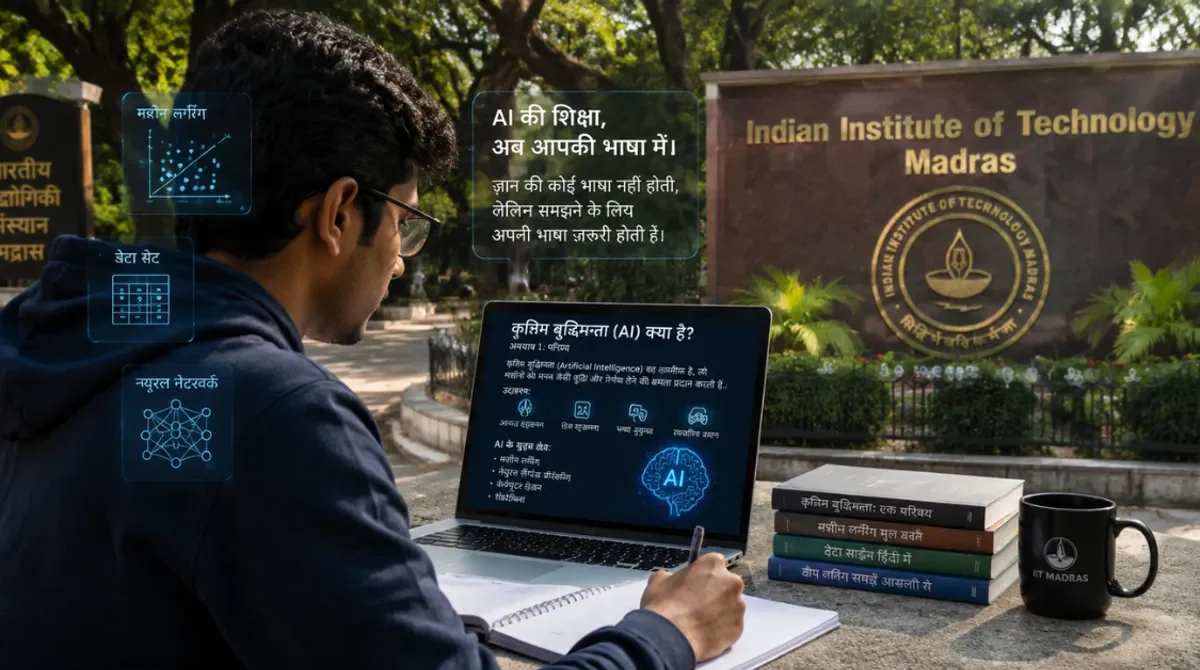
Learn how Hindi AI Learning through IIT Madras on the SWAYAM Plus platform is breaking language barriers and opening tech opportunities for regional students across India.
Hindi AI learning opens new doors for students through IIT Madras: A Shift in Technical Education
The landscape of technological education across India is witnessing an unprecedented shift toward digital inclusivity. For many years, advanced domains such as data science and machine learning have been perceived as elite fields accessible only to individuals with deep technical backgrounds and high proficiency in English. This systemic barrier has often left brilliant minds from diverse backgrounds feeling disconnected from the rapid advancements shaping the global economy.
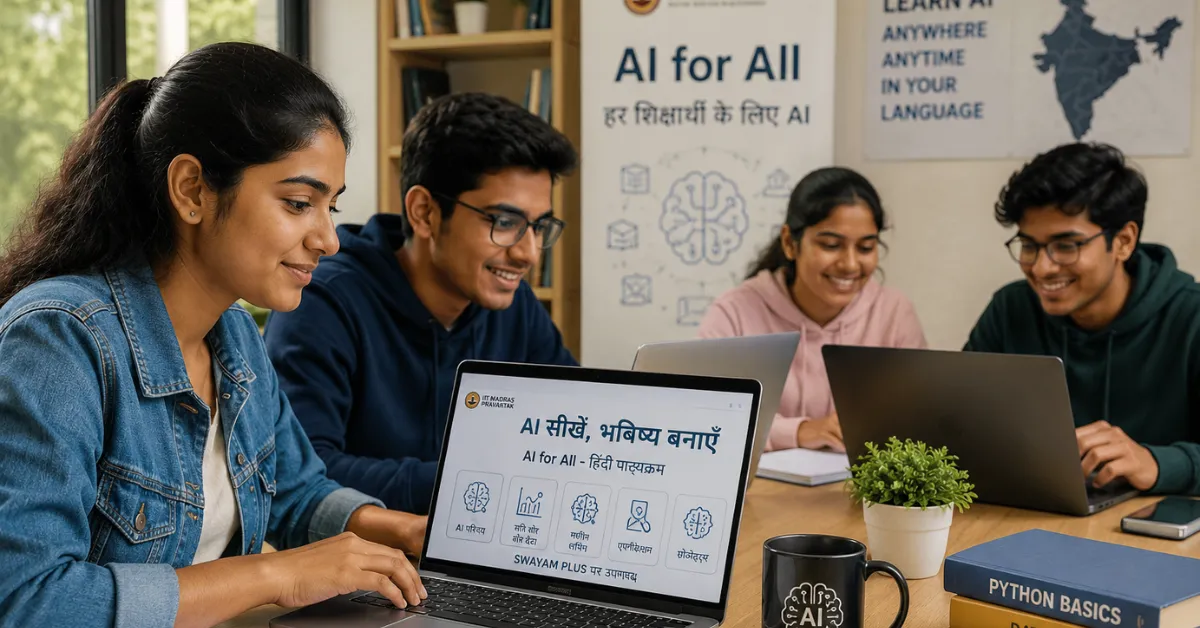
To address this glaring disparity, the Indian Institute of Technology Madras has stepped forward with a visionary approach designed to democratize access to technology. By launching a suite of specialized courses on the SWAYAM Plus platform,they are prioritizing Hindi AI learning to open the floodgates for thousands of eager minds.The widespread adoption of Hindi AI learning marks a pivotal milestone in this educational journey, ensuring that linguistic limitations no longer dictate a student’s capabilities.
Historically, the mastery of cutting-edge software tools required navigating dense textbooks written almost exclusively in English. For a learner studying in a regional language medium school, this created a double challenge of grasping complex mathematical concepts while simultaneously decoding an unfamiliar vocabulary. The psychological stress of this dual cognitive load often resulted in complete avoidance of technical streams. Realizing that true innovation cannot be restricted by language, academic leaders decided to reconstruct the foundational approach to technical literacy. Through the introduction of Hindi AI learning, the focus has successfully shifted from linguistic deciphering to pure conceptual comprehension, allowing students to engage directly with the core logic of modern algorithms.
The Digital Infrastructure and Collaboration
The digital vehicle for this massive transformation is SWAYAM Plus, an online ecosystem managed by the central government to provide high quality certification programs nationwide. The platform serves as a critical bridge between academic theory and practical industry requirements, offering flexible schedules that accommodate both full time students and working professionals.
By utilizing this infrastructure, the institute can deliver university level knowledge directly to any individual with a basic internet connection. The integration of Hindi AI learning into this public database has effectively removed geographical boundaries, allowing a student in a remote village to receive the same standard of training as someone residing in a major metropolitan tech hub. This democratization is crucial for raising the overall gross enrollment ratio and building a future-ready workforce across the nation. Learn more about these opportunities directly on the official portal at https://swayam.gov.in/, which acts as a central repository for public digital education.
The structural backbone of this initiative relies on a close partnership with the IIT Madras Pravartak Technologies Foundation, a non-profit organization focused on technological innovation. By blending academic research with practical insights from startups, the foundation ensures that the course material remains highly relevant to current market demands.
They recognized early on that teaching pure programming theory often intimidates beginners who have never touched a computer terminal before. Therefore, the curriculum was built from the ground up to emphasize practical use cases rather than abstract syntax. The strategic rollout of Hindi AI learning has allowed the foundation to reach demographics that were previously considered unreachable by premier technical institutions. This collaborative framework proves that when academia and industry align their goals, they can create scalable solutions that empower communities.
Diverse Curricula for Real-World Application
To understand the full impact of this movement, one must examine the diverse array of subjects covered within the program. The curriculum does not simply offer a generic overview of automation; instead, it provides tailored paths for specific professions and academic interests. For instance, school teachers and university faculty members can enroll in a dedicated module focused on modern pedagogy. Through Hindi AI learning, these educators are discovering how to integrate smart tools into their daily routines, allowing them to automate grading systems, generate interactive lesson plans, and create engaging visual content for their classrooms. This training shifts their role from passive consumers of digital utilities into active coordinators of technology-driven learning environments.
In the commercial sector, the transformation is equally profound as financial practices evolve alongside digital tools. Traditional bookkeeping and financial analysis are experiencing radical shifts due to automated data processing and algorithmic auditing. By engaging with Hindi AI learning, commerce students and professional accountants can master advanced techniques such as automated fraud detection, predictive financial modeling, and natural language report generation. The lessons are conducted using familiar accounting terminology presented in a native framework, which helps traditional clerks transition into modern data analysts without losing their professional footing.
Sports analytics has also emerged as an exciting gateway for first-time learners who might otherwise avoid technical streams. Cricket serves as a brilliant case study for teaching complex statistical theories. Through the lens of Hindi AI learning, enthusiastic students can explore how match data, pitch conditions, player metrics, and historical performance patterns are processed to make strategic real-time decisions. By analyzing real-world sports datasets, participants learn the fundamentals of data visualization and predictive algorithms without feeling overwhelmed by dry academic theories. This unique approach meets the learners exactly where their natural interests lie, transforming a casual hobby into an analytical skill set.
The scientific disciplines are also experiencing major upgrades through the application of algorithmic modeling. In physics laboratories and classrooms, students often struggle to visualize complex thermodynamic systems. Utilizing Hindi AI learning enables undergraduate and postgraduate physics scholars to build computational models that simulate these intricate natural phenomena. Similarly, in the field of chemistry, researchers face the massive challenge of predicting molecular behaviors and analyzing spectral data. By incorporating Hindi AI learning into their research toolkits, chemistry students can leverage data-driven analysis and molecular docking simulations to accelerate their laboratory discoveries.
For those who wish to venture directly into the mechanics of software creation, the program provides a robust foundational course in programming languages. Python has become the industry standard for developing intelligent systems, yet its syntax can seem like an alien language to someone without prior exposure. The structured approach of Hindi AI learning introduces the fundamentals of Python, linear algebra, basic statistics, and optimization principles in an accessible format. Beginners learn to navigate development environments like Google Colab using step-by-step explanations that ground abstract coding principles in practical reality.
Scaling Access and Overcoming Complexity
The public response to this bilingual push highlights a massive, latent demand for inclusive technical training across the country. The initial launch of the campaign attracted over forty two thousand eager participants, signaling a strong desire for accessible education. As word spread through academic networks, the subsequent edition recorded over fifty thousand registrations. This continuous expansion in student enrollment numbers solidifies the importance of Hindi AI learning as a permanent fixture in modern higher education. The staggering metrics demonstrate that students are not afraid of advanced technology; they are simply seeking an educational framework that respects their linguistic comfort zone.
Translating high level engineering concepts into a regional language without losing technical precision is a highly complex task. To achieve this at a national scale, the development team utilizes sophisticated computational translation tools to create the initial drafts of the course content. However, relying solely on automated systems can lead to literal translations that sound unnatural. To maintain the highest standards of academic clarity, expert educators manually review every video script, reading module, and assessment quiz. This careful combination of automated translation and meticulous human verification ensures that Hindi AI learning remains fluid, engaging, and accurate, striking the perfect balance between global technical standards and regional linguistic nuances.
This methodical philosophy is beautifully encapsulated in what the organizers call the Centre for Human-Centric AI, or the CHAI initiative. The core belief of this framework is that technology must always serve human needs rather than forcing humans to adapt to rigid machine structures. In practice, this means that every online module begins by introducing general ideas and philosophical concepts before introducing any programming code. By prioritizing user comfort and emotional confidence, Hindi AI learning helps demystify the aura of complexity that often surrounds computer science. The instructors focus on turning anxiety into curiosity, ensuring that learners view automation as a collaborative assistant.
Impact on Classrooms and Regional Learners
The ultimate validation of this educational model comes from the real experiences of individuals who have used these courses to transform their daily work. Consider the journey of Prabhakar Shetti, a thirty-six-year-old doctoral researcher in chemistry working in Mumbai. Despite nearing the completion of his advanced degree, the domain of artificial intelligence had always felt like a distant territory reserved for software engineers. Enrolling in the bilingual tracks allowed him to master data handling and Python programming within a matter of weeks. His engagement with Hindi AI learning allowed him to see these computational tools not as abstract mathematics, but as practical expansions of his laboratory toolkit, enabling him to simulate molecular structures with far greater efficiency.
A similar sentiment of empowerment is echoed by educators who operate on the front lines of regional instruction. Alok Devedi, a passionate teacher and digital content creator based in Varanasi, views this linguistic transition as an essential victory for classroom inclusivity. He notes that when a student is forced to learn complex technical concepts in a foreign language, a massive amount of cognitive energy is wasted simply trying to translate the vocabulary. By shifting the medium of instruction to the native language, Hindi AI learning allows the human brain to focus entirely on the subject matter’s logical architecture. This structural shift helps individuals transition from being passive consumers into confident creators.
Despite the widespread praise, the journey of implementing bilingual technical education also reveals unique challenges that require constant adaptation. Feedback indicates that students who completed their primary education in English-medium schools occasionally experience minor confusion when technical terms are translated too strictly into Hindi. This valuable insight shows that a rigid approach cannot satisfy the diverse needs of modern Indian students. Consequently, the program creators are refining their methods to offer a more flexible, bilingual support system where core definitions remain accessible in both languages. This ongoing adjustment ensures that Hindi AI learning can cater to those who require native explanations as well as those who prefer a blended approach.
Flattening the Educational Playing Field
The long-term societal benefits of this democratic shift extend far beyond individual classrooms or single academic semesters. By intentionally targeting learners residing in Tier 2 and Tier 3 cities, where access to expensive coaching institutes is often non-existent, this program is actively flattening the educational playing field. Providing free, high-quality instruction allows youth from economically modest backgrounds to acquire competencies that are highly valued in the contemporary job market. The expansion of Hindi AI learning serves as an economic catalyst, enabling regional talent to secure remote work opportunities, contribute to local industrial automation, and launch independent entrepreneurial ventures without needing to migrate to expensive megacities.
As artificial intelligence continues to reshape global industries, the question of who gets to participate in this technological revolution becomes increasingly critical. Initiatives that lower the entry barriers ensure that technology develops in a way that reflects the needs of the entire population. The successful implementation of this regional language initiative by a premier institution like IIT Madras sets a powerful precedent for other universities across the globe.
It proves that the true measure of institutional excellence lies not in how many people it excludes through rigorous, language-based gates, but in how many people it can successfully uplift and empower through thoughtful, accessible pedagogy. Through continuous innovation, collaborative industry alignment, and a profound respect for cultural diversity, this program ensures that the future of technology remains thoroughly human-centric and universally accessible.
Cultivating a Sustainable Digital Landscape
To achieve this sustainability, the development teams are actively training selected course graduates to become future mentors and instructional coordinators within their respective regional clusters. This peer training strategy ensures that the body of knowledge continues to grow organically without requiring constant central intervention from premier institutes. The institutional scaling of Hindi AI learning relies heavily on this decentralized mentorship network, transforming passive online learners into active educational ambassadors who can guide the next generation of curious minds through their initial technical hurdles. This sustainable cycle of knowledge transfer guarantees that the democratization of technology remains an ongoing, self perpetuating reality.
Ultimately, the overarching success of this educational revolution reminds us that human intelligence and creative potential are not bound by linguistic limits. True progress occurs when we design educational systems that honor individual heritage while providing unhindered access to modern tools. The expanding national footprint of Hindi AI learning represents a monumental victory for cultural dignity and digital equity, ensuring that every citizen has an equal opportunity to contribute to the global technological narrative. As this inclusive model continues to mature and influence educational policies nationwide, it paves the way for a more balanced, prosperous, and self reliant future where technology serves as a universal bridge for human advancement.
Also Read: Growth and Empowerment; 1 big Aspirations to Achievements: